News
As high-speed optical modules such as 800G and 1.6T continue to evolve toward higher power density and more compact designs, effective thermal management has become increasingly critical.
Meanwhile, pluggable optical modules require frequent insertion, removal and field servicing. Thermal interface materials (TIMs) must therefore provide not only low contact thermal resistance but also sufficient mechanical durability to withstand repeated friction, mechanical stress and long-term thermal cycling.
Conventional PCM sheets provide excellent interface conformity but may be susceptible to deformation, tearing or material displacement during repeated servicing.
To address these challenges, Singleton developed the TPC95 Series, featuring reinforced PCM structures that combine thermal interface performance with enhanced mechanical stability. The flagship TPC95S Stainless Steel-Reinforced PCM is specifically designed for serviceable high-speed optical module applications.
| Solution | Primary Problem Addressed | Recommended Application | Limitations / Selection Considerations |
|---|---|---|---|
| Pure PCM Sheet | Provides phase-change wetting and interface gap filling to improve contact thermal resistance. | Fixed assemblies or interfaces with infrequent removal, low insertion/removal friction and independent mechanical retention. | No dedicated reinforcing layer; tearing, deformation, debris and edge integrity must be evaluated under repeated insertion/removal. |
| Stainless Steel + PCM (TPC95S, Featured) | PCM provides interface wetting; the stainless-steel substrate provides mechanical support and reduces the risk of tearing or damage during insertion/removal. | High-speed pluggable optical modules requiring field replacement/service, higher insertion stress or sheet shape retention. | Check reinforcing-layer thickness, assembly orientation, compression and contact pressure to avoid excessive stiffness that could impair conformity. |
| Other Reinforced Substrate Versions: PI / BeCu | Provide alternative balances of mechanical strength, flexibility and structural compatibility. | Applications with specific space or structural-stress constraints where substrate selection must be matched to the optical-cage design. | Select based on actual insertion force, uneven loading, thickness allowance and reliability data; do not judge performance by substrate name alone. |
Compared with conventional unsupported PCM sheets, this design provides enhanced mechanical support while maintaining effective thermal interface contact.
TPC95S combines a 0.2 mm PCM layer with a 20 μm stainless-steel substrate, providing a balance between thermal conformity and mechanical reinforcement.
According to the available test documentation, TPC95S underwent angled insertion/removal tests:
No visible material damage was observed in the documented post-test inspection images. The product specification also identifies a durability target of up to 1,000 insertion/removal cycles.
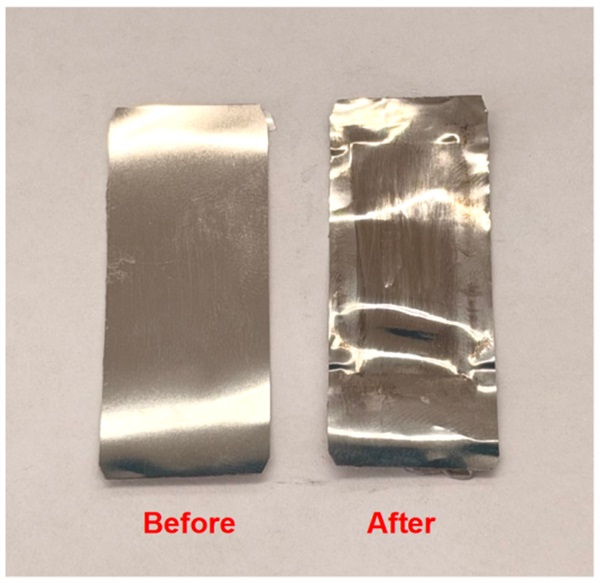
Figure: Insertion/removal and angled insertion/removal test photos from the source documentation (50 cycles at 15° pitch and 50 cycles at 7° yaw; no damage is indicated after testing).
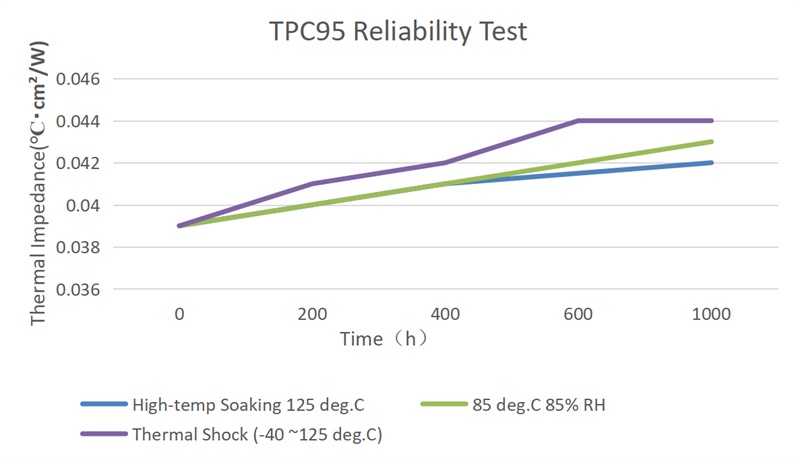
Following 85°C/85% RH high-temperature and high-humidity testing and thermal shock testing from -40°C to 125°C, the measured change in thermal resistance was less than 10%, demonstrating good thermal performance retention under the specified test conditions.
The series offers three reinforcing substrate options to accommodate different optical module structural requirements.
| Model (per specification table) | Reinforcing Substrate | Substrate Thickness | PCM Thickness | Phase-Change Point | Operating Temperature |
|---|---|---|---|---|---|
| TPC95S | Stainless Steel | 20 μm | 0.2 mm | 45°C | -40 to 150°C |
| TPC95TP | PI | 25 μm | |||
| TPC95BC | BeCu | 80 μm |
| Performance Item | Parameter |
|---|---|
| Thermal Conductivity | Up to 9.5 W/(m·K) |
| Interface Thermal Resistance | Specification table: 0.95 °C·cm²/W for TPC95S at 10 psi |
| Phase-Change Point | 45°C |
| Operating Temperature | -40 to 150°C |
| Durability | 1,000 cycles |
| Flammability Rating | UL 94 V-0 |
| Structure | 0.2 mm PCM + 20 μm stainless-steel substrate (TPC95S) |
The TPC95 Series is designed for high-speed optical modules requiring reliable thermal contact and mechanical durability.
TPC95S (Stainless Steel + PCM): Recommended for frequently serviced optical modules requiring enhanced mechanical reinforcement and insertion/removal durability.
TPC95TP (PI + PCM): An alternative for applications requiring a different balance of flexibility and structural support.
TPC95BC (BeCu + PCM): Suitable for application-specific mechanical and structural requirements.
Material selection should consider optical cage design, insertion force, contact pressure, available thickness and expected service cycles.
As optical modules advance toward higher speeds and power densities, thermal interface materials must deliver both effective heat transfer and reliable mechanical performance.
With its composite design, the Singleton TPC95S Stainless Steel-Reinforced PCM combines phase-change interface wetting with stainless-steel mechanical support, helping reduce the risk of material damage during repeated insertion and removal.
The TPC95 Series provides a dedicated thermal interface solution for high-speed pluggable optical modules, supporting reliable thermal management and field serviceability.
Singleton provides application-specific material evaluation to help customers identify the right thermal interface solution for their optical module designs.