News
As AI servers, high-performance computing (HPC), power electronics and high-speed optical modules continue to advance toward higher power densities and more compact designs, thermal resistance at the interfaces between chips and heat sinks, vapor chambers or cold plates has become a key factor in heat-transfer efficiency. Microscopic surface irregularities can trap air and reduce interfacial contact. Thermal interface materials (TIMs) must therefore deliver not only effective heat conduction, but also conformability, controlled bond-line thickness and compatibility with the intended application process.
To address different device architectures and manufacturing requirements, SG offers three complementary liquid metal TIM solutions: SG TSP800LM for highly compressible conformal contact, SG TPC800LM for a sandwich-structured low-resistance interface, and SG TGL100LM for phase-change paste application. Each is designed to meet distinct requirements at high-heat-flux interfaces.
Liquid metal materials can be engineered in different formats and for different application processes to accommodate assembly tolerances, control interfacial thermal resistance, manage material migration and enable coating in complex areas. Product selection should take into account the interface gap, clamping conditions, device architecture, material compatibility and production-line process.
SG TSP800LM: High thermal conductivity and compressibility help accommodate assembly tolerances.
SG TPC800LM: An ultra-thin, low-resistance interface with a design intended to limit material overflow for reliable packaging.
SG TGL100LM: Dispensing, screen-printing and thin-layer coating capabilities support precision application and scalable manufacturing.
Based on an indium-alloy system, SG TSP800LM is supplied as a sheet material that combines high thermal conductivity with compressive conformability. With thermal conductivity of ≥80 W/(m·K) and compression of >60%, it can accommodate variations in interface flatness and assembly tolerances, helping improve contact consistency. The sheet can be die-cut to match device dimensions, making it suitable for thermal interfaces with varying gap conditions that require stable assembly.
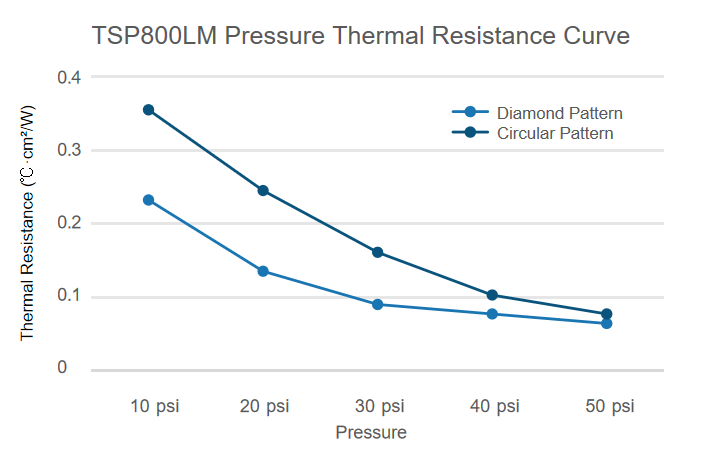
| Parameter | Typical Value |
|---|---|
| Material System | Indium-based alloy |
| Thermal Conductivity | ≥80 W/(m·K) |
| Thickness Range | ≥0.15 mm |
| Compression | >60% |
| Density | 7.3 g/cm³ |
| Volume Resistivity | 8.4 × 10⁻⁸ Ω·m |
| Product Form | Sheet |
Target Applications: High-heat-flux interfaces in liquid-cooled data centers and high-power computing modules, power modules, high-speed optoelectronic components, and radar/RF assemblies. Specific applications should be validated against device structure, clamping force and electrical-isolation requirements.
Free-flowing liquid metals offer excellent thermal conductivity and wetting. In practical packaging, however, overflow, material migration and interface consistency can present challenges for volume manufacturing. SG TPC800LM uses a composite structure to balance low interfacial thermal resistance with material containment.
SG TPC800LM features a three-layer, indium-based metallic sheet structure. A low-melting-point alloy forms a liquid-metal microstructure on the surface of the indium-based substrate, while the intermediate layer provides mechanical support through a higher-melting-point, highly conductive metal. The low-melting-point surface is intended to reduce contact resistance, while the composite construction helps restrict material overflow.
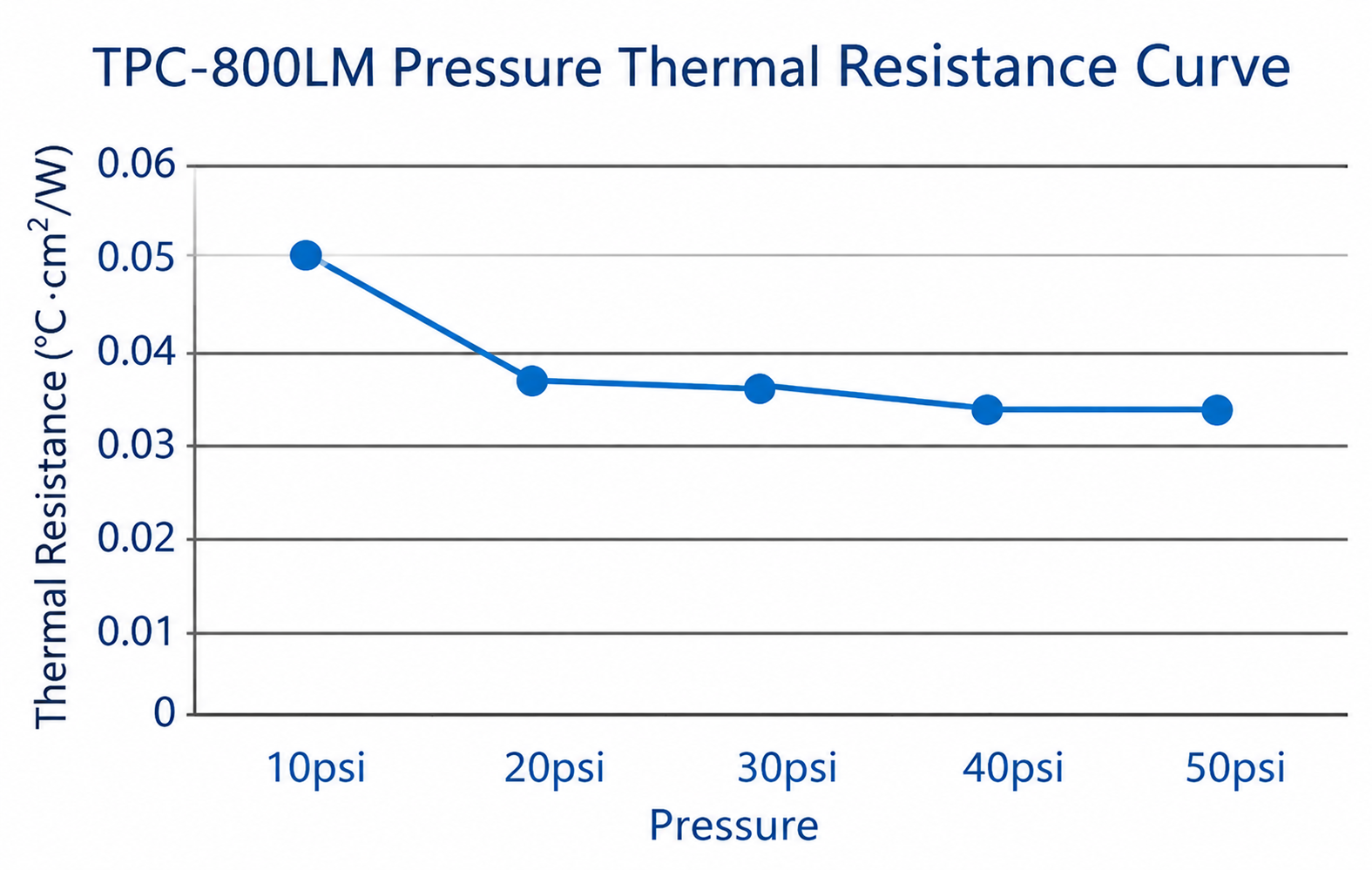
| Parameter | Typical Value |
|---|---|
| Thermal conductivity | ≥80 W/(m·K) |
| Material structure | Three-layer indium-based metallic sheet |
| Thickness range | ≥0.1 mm |
| Operating temperature | −40 to 150 °C |
| Melting point | Customizable |
| Density | 7.3 g/cm³ |
| Form | Sheet |
Target Applications: Evaluation in high-power electronic devices where low interfacial thermal resistance and control of material overflow are important. The applicable range, thermal performance and reliability must be validated against the formal product datasheet, device architecture and actual operating conditions.
SG TGL100LM is based on a polymer–liquid metal composite system. Supplied in paste form, it combines interfacial heat transfer with process flexibility. The material supports manual dispensing and screen printing, with a minimum bond-line thickness of 25 μm. It is suitable for localized precision application, complex geometries and ultra-thin interface designs. Product documentation also indicates good wettability and high thixotropy, along with resistance to pump-out, cracking and slumping.
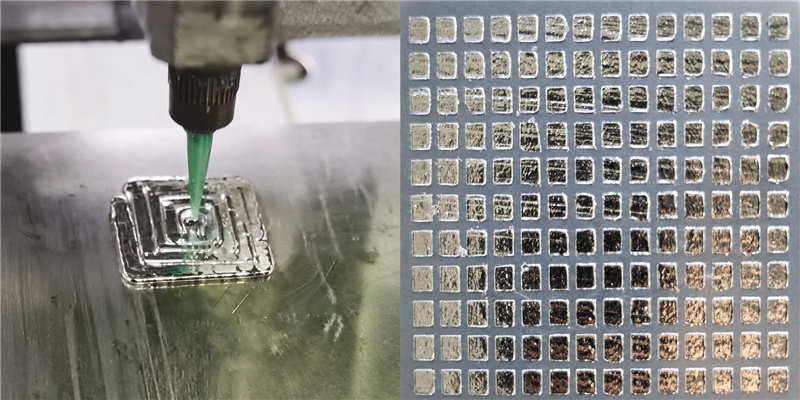
SG TGL100LM Dispensing and Screen-Printing Processes
| Parameter | Typical Value / Process Condition |
|---|---|
| Material System | Polymer–liquid metal composite |
| Thermal Conductivity | ≥10 W/(m·K) |
| Thermal Resistance | 0.035 °C·cm²/W @ 40 psi |
| Minimum Bond-Line Thickness | 25 μm |
| Operating Temperature | −55 to 200 °C |
| Volatility | <0.02% |
| Application Methods | Manual dispensing; screen printing |
| Curing Conditions | 150 °C × 10 min, 400 kPa |
| Product Form | Paste |
Target Applications: High-performance computing chips such as CPUs and GPUs, high-speed optical modules and compact optoelectronic devices, as well as high-temperature industrial electronics and power devices. For production-scale implementation, curing temperature, pressure and process takt time should be included in the process evaluation.
Together, the three products form a liquid metal TIM portfolio. The key to selection is not simply identifying which product is 'best', but determining which solution best matches the interface tolerances, applied pressure, bond-line thickness, overflow-control requirements and manufacturing process.
Selection Guide for SG Liquid Metal TIM Products
| Product | Key Advantages | Best-Suited Interface Requirements | Potential Applications |
|---|---|---|---|
| SG TSP800LM | ≥80 W/(m·K); >60% compression; sheet format | Large-area interfaces with variations in flatness, gap and assembly tolerances | Liquid-cooled data centers, high-power modules, optoelectronic components, radar |
| SG TPC800LM | ≥80 W/(m·K); ≥0.1 mm; sandwich structure designed to limit overflow; low-pressure, low-resistance interface | Ultra-thin, low-pressure, low-resistance packaging where overflow control is critical | AI chips, CPUs/GPUs, SiC/IGBT devices, lasers |
| SG TGL100LM | 0.035 °C·cm²/W @ 40 psi; 25 μm minimum bond line; dispensing and printing compatible | Complex coating areas, ultra-thin interfaces and high-volume printing processes | CPUs/GPUs, optical modules, high-temperature industrial electronics, power devices |
For interfaces with assembly-tolerance variations, SG TSP800LM offers high compressibility to help maintain contact. Where low thermal resistance and overflow control are priorities, SG TPC800LM provides a composite structure. For precision coating and scalable manufacturing, SG TGL100LM offers a paste-based application route.
This portfolio enables SG liquid metal solutions to address a range of applications, from high-performance chips and liquid-cooled servers to power electronics and precision optical modules, without forcing a single material format to fit every interface design.
The value of a liquid metal TIM cannot be defined by thermal conductivity alone. Its real-world performance depends on whether it can consistently create a low-resistance interface that is manufacturable and verifiable in the target device.
SG TSP800LM, SG TPC800LM and SG TGL100LM extend the use of liquid metal TIMs through three distinct approaches: highly compressible conformal contact, a sandwich-structured low-resistance interface, and a phase-change paste application process.
As AI computing, power electronics and high-speed optical communications continue to evolve, thermal management materials must address three practical questions: Can heat be transferred efficiently? Can the interface remain stable over time? Can the process be reproduced consistently on the production line? SG's three liquid metal TIM solutions are developed to address these requirements.